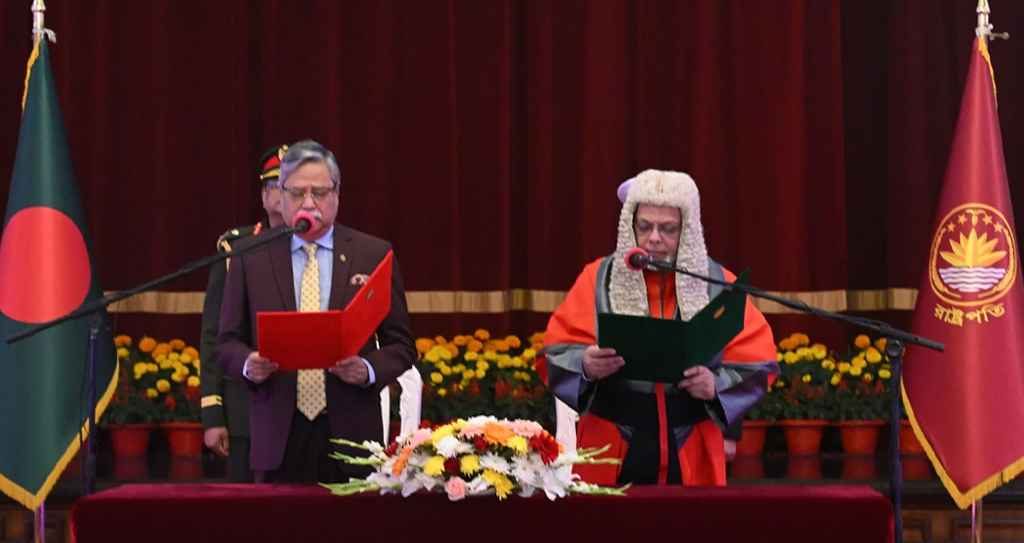
Justice Zubayer Rahman Chowdhury Assumes Office as Chief Justice of Bangladesh
1 minute to read
Justice Zubayer Rahman Chowdhury, a judge ofthe Appellate Division of the Supreme Court, has been sworn in as the 26th Chief Justice of Bangladesh.
The oath taking ceremony was held at the Durbar Hall of the Bangabhaban and it was given by the President Mohammed Shahabuddin. The event was attended by Chief Adviser Professor Muhammad Yunus, advisers to the interim government, senior members of the judiciary, the chiefs of the three-armed services and representatives of the legal profession including the leaders of the Supreme Court Bar Association. The ceremony was officially performed by the Cabinet Secretary, Dr Sheikh Abdur Rashid, around 10.35 a.m.
The appointment was made by the President under the exercise of powers conferred under Article 95(1) of the Constitution of Bangladesh following a notification in the gazette of the Ministry of Law on 23rd December, which had expressed that the act of appointment will take effect on the date of assuming office. Justice Chowdhury is the successor to Chief Justice Syed Refaat Ahmed whose term ended with his retirement on 27 December.
Justice Chowdhury has had a distinguished legal and judicial record over virtually forty years. He was enrolled as an Advocate in the District Judges Court in 1985 and admitted to practice before the High Court Division of the Supreme Court in 1987. He was appointed as extra judge of High Court Division on 27th August 2003 which he became permanent two years later. On 13th August 2024 he was elevated to the Appellate Division of Supreme Court.
He has LLB (Honours) and LLM degrees from the University of Dhaka as well as Master’s degree in International Law from the United Kingdom. Throughout his judicial career, Justice Chowdhury has been involved in various international conferences, seminars, and professional training programmes in Belgium, Canada, Malaysia, Singapore and Nepal which have provided for continued engagement with comparative and international legal practices.
The appointment of Justice Chowdhury as Chief Justice is expected to provide continuity in judicial leadership while contributing towards effective administration of justice on the basis of principles of the constitution and institutional experience.