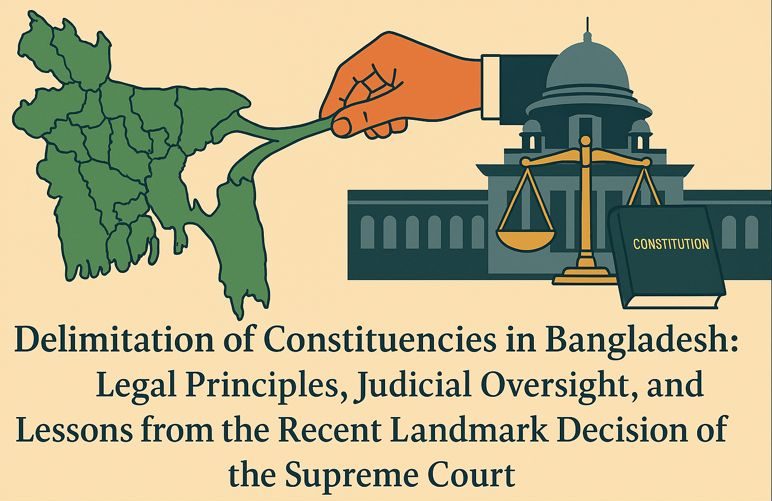
Delimitation of Constituencies in Bangladesh: Legal Principles, Judicial Oversight, and Lessons from the Recent Landmark Decision of the Supreme Court
5 minutes to read
Written by:
Barrister Tajriyaan Akram
Associate Lead – Mahbub & Company
(Member of the National Elections Inquiry Commission)
The delimitation of parliamentary constituencies plays a central role in ensuring fair representation in a democratic system. In Bangladesh, this process has always carried significant political and administrative importance, as changes to constituency boundaries affect which communities are grouped together, how resources are allocated, and how elected representatives are chosen. A recent decision of the Appellate Division of the Supreme Court of Bangladesh, delivered on 10 December 2025, has brought renewed attention to the legal principles that govern delimitation and the limits of the Election Commission’s discretion.
In this case, the Appellate Division upheld a High Court judgment that declared the Election Commission’s (EC) decision to reduce Bagerhat’s four constituencies to three as unlawful. The Court directed the authorities to restore the previous four constituencies. The judgment came from a five-member bench headed by Chief Justice Syed Refaat Ahmed, which dismissed three separate applications that sought to overturn the High Court’s decision. As a result of the ruling, four constituencies in Bagerhat were reinstated, while one constituency in Gazipur was reduced.
To understand the significance of this decision, it is important to consider the legal framework for delimitation in Bangladesh. The Constitution gives the Election Commission the authority to delimit constituencies for parliamentary elections. This power is part of the EC’s broader constitutional mandate to conduct elections independently, fairly, and in accordance with the law. Although the Commission is granted considerable discretion, it must still follow legal requirements and principles of fairness when exercising its authority.
The Delimitation of Constituencies Act 2021 provides the statutory structure for this process. Section 3 of the Delimitation of Constituencies Act, 2021 (Bangladesh) allows the election commission to determine its own procedure for conducting the delimitation. This includes the authority for publishing draft proposals, inviting objections from stakeholders, holding hearings, and then issuing a final gazette after considering all submissions. These requirements are designed to ensure transparency, public participation, and reasoned decision-making. Furthermore, Section 7 of the said Act stipulates that the validity of any delimitation or formation of a constituency decided by the Election Commission cannot be called into question in any court or by any other authority. Nevertheless, the EC has an obligation to follow its own internal procedures and as a constitutional body, it has a duty to uphold the spirit of democracy and appearance of neutrality. This includes publishing draft proposals, inviting objections from stakeholders, holding hearings, and then issuing a final gazette after considering all submissions. These requirements are designed to ensure transparency, public participation, and reasoned decision-making.
In practice, however, the courts found that the EC had failed to adhere to these procedures. Although the Commission has developed its own internal guidelines to promote transparency, including forming committees and allowing time for objections, the High Court and Appellate Division observed that the EC did not follow its own process in a meaningful way. In 2025, stakeholders submitted 1,893 objections relating to 84 constituencies, but the EC, as done traditionally, held hearings for only four days. This made it impossible to properly review the large volume of submissions. The final gazette also showed minimal changes from the initial draft, raising concerns that the objections were not genuinely considered. Moreover, the EC did not provide clear explanations for how it reached its decisions, which made the process appear rushed and lacking in transparency.
Such shortcomings gave the appearance of an arbitrary exercise of power. In administrative law, public bodies must act reasonably and provide clear justification for their decisions. When a body with significant constitutional authority, such as the Election Commission, fails to follow its own procedures or does not consider public objections properly and does not provide any explanation for its decisions, the courts may intervene through judicial review. Judicial review does not permit the courts to replace the EC’s judgment with their own, but it allows them to examine whether the Commission acted within the law they themselves formulated, followed fair procedures, and applied its discretion properly. In this case, both the High Court Division and the Appellate Division found that the EC’s actions fell short of these basic principles.
The legal dispute also highlights broader structural challenges within Bangladesh’s delimitation practices. Historically, the EC has undertaken the boundary-redrawing process under tight timelines, often prioritising administrative convenience over thorough consultation and data-driven analysis. Records show that 87 constituencies were redrawn before the 2014 elections, 25 before 2018, and ten before 2024. In each cycle, the EC tended to rely heavily on boundaries established in 2013, even when population shifts or local concerns justified a more detailed review. The 2025 delimitation cycle became a clear example of this pattern, with an overwhelming number of applications submitted but minimal changes reflected in the final outcomes.
Without strong statutory guidance on how delimitation should be carried out, the EC operates with wide discretion but insufficient accountability. Experts have long pointed out that Bangladesh lacks an independent professional body dedicated solely to constituency boundary reviews. In comparison, countries such as the United Kingdom rely on permanent boundary commissions staffed by technical experts. These bodies carry out periodic reviews based on population data, geographic factors, and extensive stakeholder consultation, helping to ensure fairness and public confidence.
The consequences of weak procedures and rushed decision-making in Bangladesh can be serious. Constituencies like Bagerhat face reduced access to public funding and diminished political representation when boundaries are altered without proper justification. Such changes can also discourage local political participation and increase public distrust in electoral institutions. Poorly documented decisions and insufficient reasoning encourage more legal challenges, creating uncertainty and placing further strain on the judiciary.
To improve the delimitation process in Bangladesh, several reforms are essential. First, the consultation period must be extended to allow meaningful participation from political actors, civil society organisations, academics, and local communities. Unlike the EC’s usual three to four-month timeframe, international practice suggests that boundary reviews should take one to two years. Second, the EC should publish clear and detailed explanations for every boundary change, including the data and principles relied upon. Third, constituency boundaries should be reviewed periodically, rather than reactively, to reflect population shifts and uphold the principle of equal voting strength.
The Appellate Division’s decision serves as an important reminder that constitutional bodies must exercise their powers responsibly and transparently. While the Election Commission’s autonomy is vital for democratic governance, that autonomy must be exercised within legal boundaries and in accordance with its own stated procedures. The judiciary’s role in such cases is not to control the Commission but to ensure that it does not act arbitrarily.
By strengthening legal safeguards, improving stakeholder engagement, and incorporating technical expertise into delimitation, Bangladesh can build a more credible and equitable framework for electoral boundary management. Doing so will align national practices with international standards and help restore public trust in the institutions that uphold the electoral process.